Mosque Foundation | Bridgeview, Illinois Logo
Mosque Foundation | Bridgeview, Illinois

Mosque Foundation

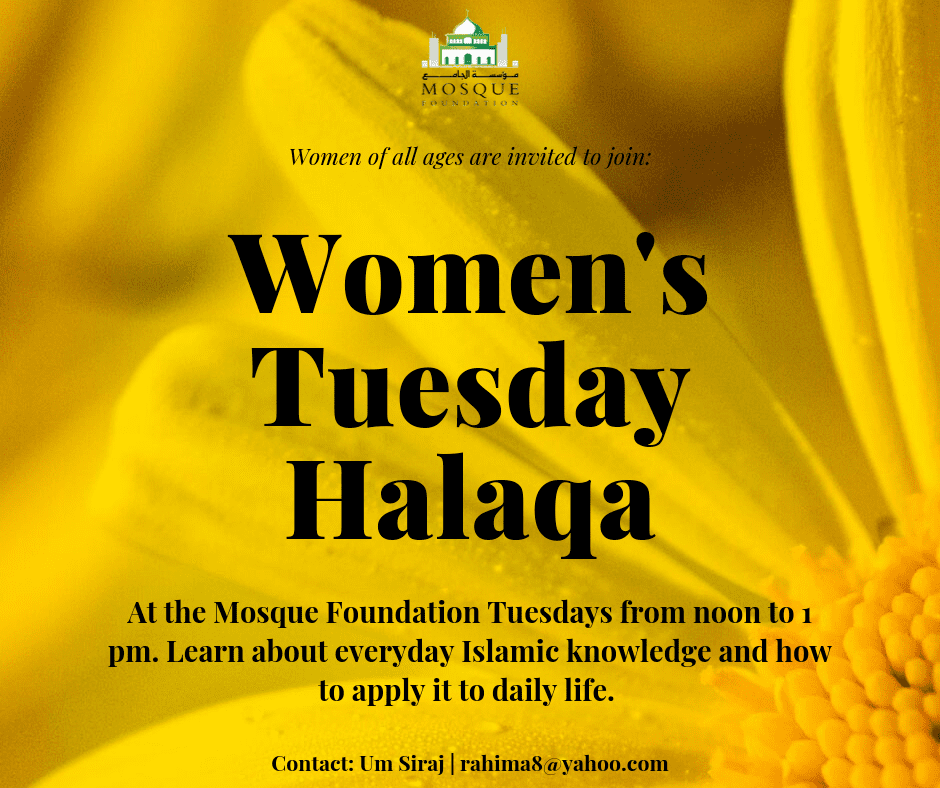
Women’s Tuesday Halaqa

First Friday Prayer is at 12:30pm. Second Friday Prayer is at 2:00pm.

Women’s Tuesday Halaqa

Every Tuesday from 12 noon until 1:00 pm, women from all ages are welcome to attend a halaqa at the Mosque Foundation. Halaqa, in Islamic terminology, is a religious gathering for the study of Islam and the Quran.  The Tuesday halaqa is lead and attended by women.

The halaqa takes place in the Women’s section of the Masjid and is conducted primarily in Arabic. Women of various ages attend, but most are mothers with young or school-aged children. Women with young children can take advantage of the childcare available on premises. The midday schedule is also convenient for women who are busy in the evenings or on the weekends but still want to participate in the masjid, seek knowledge, forge a sense of sisterhood, and boost their Iman.

The objective of the halaqa is to teach everyday Islamic knowledge and how to apply this in daily life. Topics vary from the rules of salah, the rights and duties of women in different spheres, , to the Seerah of the Prophet (Peace be Upon Him). Participants also discuss relevant issues to the community and other general topics.

This free program has been going for over 20 years, and takes place year round. The Prophet Muhammad (Peace be Upon Him) taught us that the most beloved deeds to Allah are those which are most regular and constant even though they are few. As such, it is easier to sustain our efforts when we learn consistently without periods of inactivity. This weekly halaqah offers a regular space for women to learn at a steady pace and share this knowledge with family and friends. 

For more information or if you have any questions, you may contact Sister Um Siraj at: rahima8@yahoo.com.


A Life of True Worship


One of the gaps in the classical works on Seerah, or  the life-story of the Prophet Muhammad ﷺ, is the absence of a unified image of him as a dedicated worshipper. Instead, the works are mainly concerned with the political developments and the various struggles of early Muslims. Many aspects of the character of the Prophet ﷺ are found in the Quran, books of Hadith, and Shamael (which covers intricate details of the Prophet’s ﷺ appearance and manners). This article seeks to shed some light on the Prophet’s ﷺ dedication to worship through a few examples from the Quran and Hadith that will help us recognize the heart of Muhammad ﷺ.

(1) The Quran commands the Prophet ﷺ to dedicate his life to worship.

Allah ﷻ commands the Prophet ﷺ, “And worship your Lord until death comes to you” (Quran 15:99). In another verse, Allah ﷻ says, “O you who are enwrapped ‘in a mantle’ [out of fear and awe], arise to pray during the night, except for a little ‘of it’. Or ‘pray’ half of it, or lessen the same a little, or add thereto. And ‘therein’ recite the Quran perfectly. For we shall assuredly cast upon you a weighty Word [the Quran]. And, indeed, rising at night ‘for prayer’ makes for a stronger impression ‘on the soul,’ and is best for the recitation of God’s word.’ Indeed, during the daytime you shall have lengthy occupations ‘in calling to God.’ So remember with praise the name of your Lord. Thus shall you devote yourself with sincere devotion to Him alone—the Lord of the East and the West. There is no God but Him! So take him alone as a guardian” (Quran 73: 1-8). These commands highly illustrated in the life of the Prophet ﷺ; yet, they are absent in the books of Seerah.

(2) To the Prophet ﷺ , prayer was a source of comfort.

Abdullah ibn Ash-Shikheer is reported to have said: “I came to the Prophet ﷺ while he was praying, and his chest sounded like a boiling kettle.” Salah was the favorite resort for the Prophet ﷺ on many occasions. Whenever the Prophet ﷺ faced any difficulty, he sought prayer asking Bilal to call the athan saying: “Bring comfort to us by calling it.” The Prophet ﷺ loved prayer so much that he said about it: “Salah is the pleasure of my eye.” He loved to stand before Allah; praying for a long time. According to Imam al-Bukhari, Ibn Mas’ud said: “I prayed with the Prophet ﷺ one night, and his standing was so long that I thought of something bad!” He was asked: “What did you think of?” His reply: “To sit down and leave him [the Prophet] standing!”

There are many Hadith that explain how devoted the Prophet ﷺ was to prayer despite his sinless life. For instance, Imam Muslim reported on the authority of Aisha (may Allah be pleased with her): “The Prophet ﷺ kept standing (in prayer) so long that the skin of his feet would crack. I asked him: “Why do you do this, while your past and coming sins are forgiven?” He said, “Should I not be a grateful servant of Allah?” Thus the Prophet’s ﷺ closeness to Allah ﷻ did not lead him to pride. On the contrary, it led him to more humility and worship as a proof of gratitude to Allah ﷻ. In another Hadith, Aisha, (may Allah be pleased with her), described the Prophet’s ﷺ Salah: “Indeed, the Prophet ﷺ used to pray eleven rak’as. This is how he used to pray [at night]. His Sujud would last as long as one of you takes to recite fifty ayat. Thereafter, he would pray two rakats before Fajr prayer; then, he would lie down on his right side untl the athan for Salah is called” (Reported by al-Bukhari).   

(3) The Prophet ﷺ had frequent Munajah or intimate conversations with Allah ﷻ.

Ibn Abbas reported that the Prophet ﷺ used to say when waking up for voluntary night prayer: “O Allah, to you is all praise. You are the Sustainer of the heavens and the earth and what is therein. To You is all praise. To You is the kingdom of the heavens and the earth and what is therein. To You is all praise. You are the Light of the heaven and the earth and what is therein. To You is all praise. You are the King of the heavens and the earth. To You is all praise. You are the Truth, Your promise is the Truth, Your word is the truth, heaven is true, hell is true, prophets are true, and Muhammad is true. O Allah, to You I submit, in You I believe, on You I put my trust, to You I turn, with Your help I give arguments, and You do I take as a Judge. So forgive my sins past and future, secret and public for no one forgives sins but You.” (Reported by Imam Muslim).

(4) The Prophet ﷺ had a heartfelt relationship with the Quran.

The Prophet’s ﷺ heart was so soft that he would weep whenever he listened to the Quran, especially the verses that remind him of his prophetic tasks. Ibn Mas’ud said: “Prophet Muhammad ﷺ said to me, ‘Recite the Qur’an for me.’ I said, ‘O Messenger of Allah, shall I recite the Qur’an for you, whereas it has been revealed to you?’ He replied, ‘I love to hear from others.’ Upon this I started reciting Surat An-Nisa. When I reached the Ayah: ‘How [shall it be] then, when We bring from each nation a witness and We bring you [O Muhammad] as a witness against these people?’ (Quran 4:41) He said, ‘That is enough.’  When I looked at him, his eyes were tearful” (Narrated by Imam al-Bukhari and Imam Muslim).


(5) The Prophet ﷺ used to contemplate on the glory and creations of Allah ﷻ.

Imam al-Bukhari reported that Ibn Abbas said: “While I was staying with my aunt Maymounah, [I noticed that] the Prophet ﷺ spent some time conversing with his family, and then he  slept. At the last third of the night, the Prophet ﷺ woke up and looked at the sky and recited: ‘Indeed, in the creation of the heavens and the earth and the alteration of night and day are signs for those who reflect. Those who remember Allah while standing, sitting and lying down on their sides, and think deeply about the creation of the heavens and the earth, saying: ‘Our Lord, You have not created this in vain. Holy be You. So save us from the torment of the hellfire’ (Quran 3:190-191).Thereafter, the Prophet ﷺ made wudu’ and then prayed eleven rak’as. Thereafter Bilal called the athan. Then the Prophet ﷺ prayed two rak’as and went out to offer the morning prayer [in congregation] with people.”

(6) The Prophet ﷺ frequently fasted.

Here is a list of his fasts:

     a) The month of Ramadan.

     b) The month of Sha’ban except for a few days. 

     c) Mondays and Thursdays of each week.

     d) The 13th, 14th, and 15th of every Hijri month even if he was traveling.

     e) The 9th of Muharram and the 9th of Dhul-Hijjah

     f) Al-wisal fasting; that is, to fast successive days without breaking the fast at all. However, the Prophet ﷺ forbade his companions from this kind of fasting, saying: “It is my Lord Who feeds me!” 

    g) Sometimes, if he woke up and found no food for breakfast, he would intend fasting that day until sunset.

(7) The Prophet ﷺ was a generous giver.

Ibn Abbas reported: “The Messenger of Allah is the most generous of all people; and he is extremely generous during the month of Ramadan when Jibril met with him. In Ramadan, Jibril used to meet with the Prophet ﷺ every night reciting the Quran to him. During this period, the Prophet ﷺ was more generous than the free-blowing wind!”

(8) The Prophet ﷺ practiced I’tikaf (Seclusion in the Masjid for Worship) as a spiritual vacation.

Abu Hurairah reported: The Prophet ﷺ used to observe i’tikaf every year (during Ramadan) for ten days. However, in the year when he passed away, he observed i’tikaf for twenty days [Al-Bukhari].

(9) The Prophet ﷺ was a role model in seeking God’s forgiveness.

In his Sahih, Imam Muslim reported, on the authority of al-Aghar al-Muzni that the Prophet ﷺ said: “Sometimes I forget [thikr of Allah], and I would do istighfar [asking Allah for forgiveness] more than one hundred times a day.” It is noteworthy to mention that the Prophet ﷺ considers his ‘forgetfulness’ a sin! We all understand that any religious act missed out of ignorance or forgetfulness can be excused or made up. However, because of his higher level of faith, the Prophet ﷺ considered his forgetfulness a sin that requires repentance. Here is an example of the Prophet ﷺIstighfar, usually called Sayyid al-Istighfar (the best form of seeking God’s forgiveness) that shows the Prophet’s ﷺ humility and gratitude and complete reliance on Allah ﷻ: “O Allah! You are my Lord. No one deserves to be worshipped except You. You created me, and I am Your servant. I will constantly keep my covenant of obeying You and my expectation of getting rewarded by You as much as I can. I seek Your refuge from the evil I did. I acknowledge the blessings You bestowed on me, and I confess my sins to You; So, forgive me for no one forgives sins but You.”

(10) The Prophet ﷺ lived in the presence of Allah ﷻ.

The Prophet’s ﷺ love of Allah ﷻ was so overwhelming and genuine that anything that happened around him reminded him of Allah ﷻ. He was simply God-oriented. He had a prayer for every occasion during the day and night. He had a set of long prayers or du’as to be recited in the morning and the evening. His daily activities connected with prayers as he had sets of prayers to be recited before he slept, when he woke up, wore his clothes, wore new clothes, saw someone wearing new clothes, used the bathroom, left the bathroom …etc. Natural phenomenon around him was similarly a reminder of Allah ﷻ. For example, he had a prayer to be recited when it rained or when there was a change in the weather. It is highly recommended to check out Hisn-ul-Muslim or books of Athkar for all the daily du’as of the Prophet ﷺ to recognize his pure heart like never before.    

To conclude, the more you recognize Allah ﷻ and His attributes, the more obedient to Him you will be. That is why the Prophet ﷺ was the perfect example of showing submission to Allah ﷻ, simply because he had the perfect understanding of Allah ﷻ and His glory.

By Sh. Ahmed Arafat

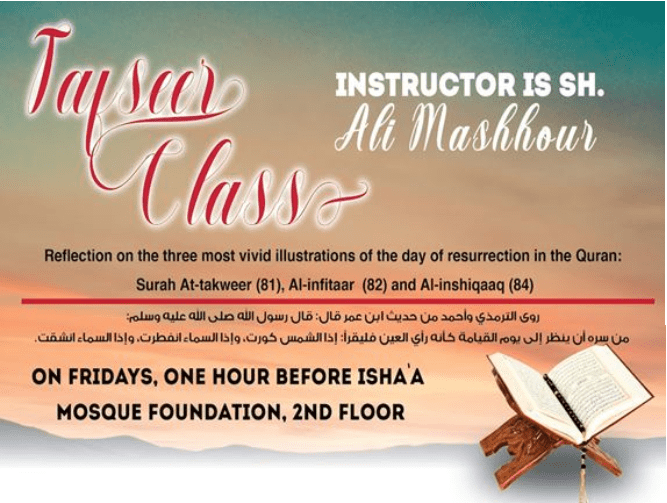
Tafseer Class

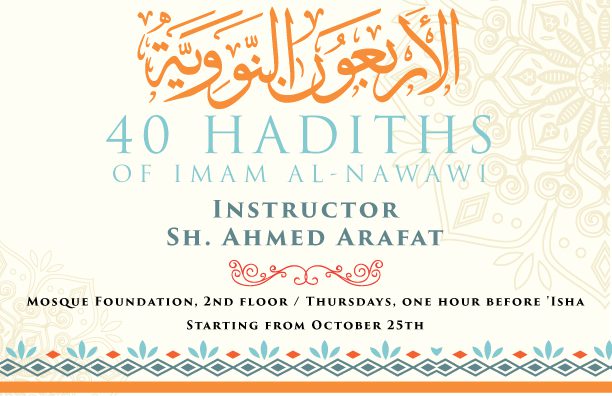
40 Hadith of Imam AL-Nawawi

Mind Your Own Business!


“A good practicing Muslim” is a phrase we usually hear in many Muslim circles. However, what usually comes to our minds when we hear this phrase? Many people may typically visualize images of praying, fasting, giving charity, reciting the Quran, and so forth. There is no doubt that such acts are ingredients for our spiritual journey; yet, Prophet Muhammad ﷺ stresses a social quality that might be neglected by many religious people. This quality serves as an indicator for one’s practice of Islam and is based on a Hadith reported by Imam al-Tirmizi, who narrated, on the authority of Abu Hurayrah, that the Prophet ﷺ said: “Part of your good practice of Islam is to leave whatever does not concern you.” 

In other words, one should mind one’s own business. The Hadith teaches that practicing Muslims should stay away from any talk or action that is of no concern. Instead, as a top priority, Muslims should be busy purifying themselves and taking care of their own faults. If people involve themselves only in the things that concern them, they will not find time to label others or waste their time in gossiping or the like. Allah says: “Successful indeed is the person who uplifts it [their soul] and a failure indeed is that the person who lowers it [their soul]” (Quran 91: 9-10). As a disclaimer, the Hadith does not encourage leading a self-centered life and disregarding people’s rights. In general, our moral and legal code determines the matters that do not concern us. Here, we seek to list examples of the quality of “leave that which is of no concern to you,” a quality that practically illustrates our embodiment of the beauty of our faith. 

Situations where you should mind your own business:

People’s Privacy

There is a difference between keeping in touch with friends and intruding on their privacy. You should treat people’s private information in the way you like yours to be treated. If you know that asking a person about their salary, spouse, or children will violate their privacy, you must avoid these questions. Similarly, one should not share personal information about people without their permission.

Judging People’s Final Destiny

There is a difference between saying this is lawful or unlawful and saying this person will surely be Heaven or Hell. Teaching people about what is permissible and what is prohibited is a religious obligation. However, a Muslim is forbidden from claiming that a specific Muslim will be doomed to Hell simply because judging people’s final destiny is an exclusive work of God Himself. To claim that a Muslim will go to Hell, regardless of their sins, is like claiming divinity—which is indeed more dangerous than any other grave sin. Moreover, such acts of judgment are heinous acts of pride. Any person who is judgmental in this way will suffer, losing all their good deeds on the Day of Judgment. Imam Muslim reported, on the authority of Jundub, that a man said: ‘By Allah, Allah will not forget this person. So Allah said: ‘Who is he who swears by Me that I will not forgive that person. Indeed, I shall forgive that person and nullify the accuser’s deeds.”

Judging people’s final destiny requires a comprehensive knowledge of people’s inner intentions, hidden actions, and all of their life circumstances. Thus, no one is qualified to determine people’s destiny due to insufficient knowledge and human prejudices. The Prophet ﷺ told us the story of a man who spent his life in excessive sins and ended up getting his sins forgiven. The Prophet ﷺ said: “There was a man who used to sin excessively. When he was about to die, he said to his family: ‘when I die, burn me, then grind my corpse and throw it in the air, because if my God got control of me, he will severely punish me. When he died, everything was done in the way he described. However, Allah commanded the earth to bring the man’s particles together, and it did. When the man appeared before Allah, Allah asked him: ‘why did you do that?’ ‘I was afraid of You, my Lord!’ Because of this [reply], the man was forgiven.” Remember the prostitute who was forgiven because of giving water to a thirsty dog to drink in the desert, as the Hadith tells us?

Claiming that sinful Muslims will be doomed in Hell will not change them. It may make them more rebellious, resistant, and indifferent. The Prophet ﷺ taught his companions about the psychology of a sinful person when being cursed. It happened that a man was brought to the Prophet ﷺ because of his frequent sin of drinking. People started throwing shoes at him! Moreover, a Muslim said to him: “May Allah keep you away from His mercy! How often you are brought here!” Upon this, the Prophet ﷺ said: “Do not ally with Satan against your brother, for this man loves Allah and His Prophet!” What a great teacher the Prophet was! Everyone was looking at the negative side of the sinner, making the man more uncaring. However, the Prophet ﷺ was looking at the bright sight that if it is rightly nurtured will lead to the best results: this man loves Allah and His Prophet.

The Past of Those Who Repent

Sometimes people repent of severe sins and become determined to lead a meaningful life as Allah ﷻ wants. However, their former bad friends may keep bothering them and discouraging them from following the Way of Allah. They keep reminding those who repent of their sins claiming that Allah is not going to forgive them. Moreover, some “good” Muslims, instead of welcoming them sincerely, may look down on them as they see them as unequal and unqualified for a change. We should understand that sin and forgiveness is something between the sinner and Allah alone. A person sinned against Allah and Allah promises them forgiveness when they turn to Him in repentance. So we have no right to interfere in this relation at all.

Finding Faults in Others

The Prophet ﷺ taught us very clearly not to search for faults in others. Fault-finding may result in making sinners worse. Mu’awiyah said: I heard the Prophet say: “Indeed if you searched for people’s faults pryingly, you would corrupt them.” Moreover, trying to find faults in others will prompt them to find flaws in you or, even worse, slander you. Abu Birzah al-Aslami narrated that the Prophet ﷺ said: “O people who believe by their tongues whereas Faith does not touch their hearts! Do not backbite Muslims and do not look for their faults. Whoever finds faults in others, Allah will find faults in them and expose them even in their home!”

Thinking badly of people usually leads to finding faults in them. That is why Allah said: “O you who have believed, avoid much [negative] assumption. Indeed, some assumption is sin. And do not spy or backbite each other. Would one of you like to eat the flesh of his brother when dead? You would detest it. And fear Allah; indeed, Allah is accepting of repentance and Merciful.” (Quran 49:12).

People’s Inner Intentions

We should avoid judging people’s inner intentions, for it is only Allah who knows them. Judging people by the way they look is most probably deceiving. The Prophet ﷺ set the rule for us as he says: “I have not been ordered [by Allah] to search into the hearts of the people or cut open their bellies.” On a battlefield, it happened that Usamah ibn Zayd killed a man though he had declared his Shahadah, claiming that the man had announced it out of fear! Immediately the Prophet ﷺ reproached him, “Did you tear his heart to find out whether it professed that or not?”

Things You Know Nothing About

Many people tend to act ‘Miss Know-It-All’ or ‘Mr. Know-It All.’ The Quran teaches: “Do not follow whatever you have no knowledge about; indeed, hearing, sight, and heart—all of these you will be questioned about” (Quran 17:36). Moreover, Mu’ath ibn Jabal reported the Prophet ﷺ as saying: “You are safe as long as you are silent. Yet when you talk, it will be counted for you or against you.”

Impractical Questions

Involving yourself in impractical questions that do not lead to anything good to be applied in your life is a waste of time and a sign of Islam’s incomplete practice. It is said that half of knowledge is the right question. The Prophet ﷺ used to direct his companions to ask the right questions of concern. One day a man came to the Prophet ﷺ asking: “When will be the Day of Judgment?” Eloquently enough, the Prophet ﷺ responded: “What did you prepare for it?” 

Matters That, If Revealed, May Hurt You

Avoid asking questions, the answer of which may bother you. Allah ﷻ said: “O believers, do not ask [questions] about things that once they are revealed to you will cause you trouble” (Quran 5:101). Imam al-Bukhari reported that the Prophet ﷺ addressed his companions, inviting them to ask questions. Abdullah ibn Huzafah As-Sahmi rose and asked: “O Prophet of Allah, who is my father? ‘Your father is Huzafah.’ When he returned to his mother, she reproached him very severely, saying: “I have never seen a man more undutiful to his mother than you are to me. We lived in the pre-Islamic era. What if I committed sins like people back then used to do? Would you like to expose me in public?”

Indeed, Allah is the All-Knowing, the All-Wise!

Be Good to Your Parents

Increase the Length of Your Life: Be Good to Your Parents

My message to you is a topic that is an emotional one for many people. Unlike some western societies and cultures that propagate the belief that parents are a burden on the individual’s sense of autonomy, Islam sends an entirely different message of both duty and compassion.  

As Muslims, we are obligated to regularly evaluate our parents’ relationships and ask ourselves what we can do to earn their pleasure. To do this sincerely, we must purge ourselves from the notion that our parents’ needs have a lesser or even equal footing with our own needs. We should not be on a constant quest to point out their shortcomings but rather question what more we can do for them as this is the decree of Allah ﷻ.

He ﷻ states, “And your Lord has decreed that you not worship except Him, and to parents, good treatment. Whether one or both of them reach old age [while] with you, say not to them [so much as], “uff,” and do not repel them but speak to them a noble word. And lower to them the wing of humility out of mercy and say, ‘My Lord, have mercy upon them as they brought me up [when I was] young'” (Quran 17:23-24).

Allah ﷻ commanded us immediately after the command of worshipping none but Him ﷻ, to treat our parents with the utmost kindness. He did not include conditions on this excellent treatment, such as whether they are Muslim or not or whether they are good parents. Allah ﷻ also commands that we are humble and merciful to them, especially in old age.

The only condition He ﷻ placed was that if their pleasure contradicts the first decree of worshipping Him alone, then we must disobey them. And even if that was the case, Allah ﷻ emphasizes that we must continue to treat them with kindness.

“But if they endeavor to make you associate with Me that of which you do not know, do not obey them but accompany them in [this] world with appropriate kindness and follow the way of those who turn back to Me [in repentance]. Then to Me will be your return, and I will inform you about what you used to do” (Quran 31:15).

Such is the divine wisdom of our Creator ﷻ who commands us to do what is right for our emotional well-being and maintain the Muslim community’s social fabric as a whole.  

What constitutes kind treatment?

Kindness to parents comprises doing everything in your power to ensure their comfort and refraining from harming them in any way. Al-Bukhari narrated the story of the three men who sought shelter in a cave when a huge rock blocked the cave entrance. They then implored Allah to save them by their good deeds. One of them said, “O Allah! I have two old parents and some young children. I took the profession of grazing (sheep or cattle) to earn a living. Whenever I returned home, I used to provide milk for them, beginning with my parents. One day, I went too far in pursuit of wood. I did not return home until it was night. I found my parents asleep. I milked as usual and brought milk and stood beside them, refraining from either awakening them or beginning with my children suffering from hunger. Thus continued our state of affairs until it was dawn.”

Treating our parents kindly also means consistently addressing them in a merciful and polite way. Umar bin Dharr, a righteous predecessor, was asked: “How was your son kind to you? He replied, “Whenever I walked during the day, he would walk behind me, and whenever I walked at night, he would walk in front of me.” We must humble ourselves to be respectful in both word and deed when interacting with them. This includes obeying them when we politely disagree with them so long as it does not contradict Islamic principles like, for example, forfeiting others’ rights. If this is the case, we must explain to them that we value their pleasure, but we cannot disobey Allah ﷻ.

According to your ability, kind treatment of parents includes supporting them spiritually, physically, emotionally, or financially. It was narrated that during the Caliphate of ‘Uthman bin ‘Affan, the price of palm trees reached one thousand dirhams. Usamah bin Zaid headed for a palm-tree that he cut off, extracted its core, and fed to his mother. The people said to him, “What made you do that, while you know that the price of a palm-tree has reached one thousand dirhams, while its core does not equal to even two dirhams?” He said, “My mother asked me to bring it to her. I always bring her anything she asks me, as long as it is in my capacity.”

We should also visit our parents and communicate with them regularly to ensure their needs are met. We should again kindly remind them to worship Allah ﷻ in every way and spend in His cause.

More than often, seeking the pleasure of one’s parents is not easy. Therefore we should make dua’a to Allah ﷻ to make achieving their happiness easy and continue to pursue it even if it is difficult because if we neglect it, we will be severely punished. Prophet Muhammad ﷺ was reported to have said, “Allah delays the punishment of sins according to His Will until the Day of Resurrection, except for unkindness to parents. Allah hastens its punishment for those who are guilty of it before their death.”

Even after their death, we must be thoughtful of our parents by making dua’a for them, giving charity on their behalf, visiting their friends, and fulfilling vows they made. May Allah ﷻ grant us His pleasure and the pleasure of our parents. May He ﷻ forgive them, bestow mercy upon them, and forgive us for our shortcomings.

By Sh. Jamal Said

Remember Him, and He Will Remember You

“So remember me, and I will remember you, and thank Me and do not be ungrateful to me” (Quran 2:152).

In this verse from the holy Quran, Allah the Most High promises us a promise that Arab linguists tell us is solemn and absolute, that every time we remember Allah, Allah will, in turn, remember us. The Prophet Muhammad (ﷺ) echoes this covenant and reiterates it in no uncertain terms, that whenever we mention Allah, no matter how fleeting, no matter how briefly, Allah will, in turn, mention us. Imam Bukhari reported in his authentic compilation on the authority of Abu Hurairah that the Messenger of Allah (ﷺ) said that Allah the Most High says: “I am with my servant each time he remembers me and his lips move with my mention” (Bukhari).

Abu Hurairah also narrates that the Messenger of Allah (ﷺ) said: “Allah the Most High says: “I am at the assumption of my servant of me, and I am with my servant each time he remembers me. If he remembers Me in himself, I remember him in Myself, and if he mentions Me in a gathering, I will mention him in a superior gathering” (Bukhari & Muslim).

In addition, there is another meaning of this verse. This verse contains layers upon layers of meaning, light upon light, and is of multiple dimensions. Another of its implications that the scholars of Qur’anic interpretation point out is a much broader one. That the verse is not merely the outward mention of Allah with one’s tongue, but rather, whenever we are moved to act based on our yearning to achieve Allah’s pleasure, that this is included in Allah’s promise. Hence, the verse is also saying: Obey me, and I shall reward you. Preserve my commandments, and I shall preserve you. Refrain from what I have prohibited, and I shall protect you from what you fear.

Ibn Abbas narrates that once when riding behind the Prophet (ﷺ), he said to him: “Young man, I am going to teach you some words of wisdom: preserve Allah’s commandments, and Allah will, in turn, preserve you. If you preserve Allah’s commandments, you will find Him there ahead of you. When you ask, ask from Allah, and if you seek aid, seek aid from Allah. Know that if the world were to collaborate to benefit you with anything, they would only benefit you with something Allah has already written. And conversely, if the world were to collaborate to harm you in any way, they could only harm you with something Allah has written upon you. The pens (of destiny) have been lifted, and the ink has already dried (Tirmidhi). In another wording, he added: “Preserve Allah’s commandments, and you will find Him before you. Know Allah in your times of ease, and He will know you in your times of difficulty. Know that whatever has missed you was never meant to afflict you, and whatever afflicts you could never have missed you. Know that victory comes with patience, that relief comes with a crisis, and that hardship comes with ease” (Ahmad).


The Deputy Prime Minister of Turkey Visit

The Mosque Foundation was honored to welcome the Deputy Prime Minister of Turkey, Professor Nauman Kurtulmus for Jum’ah Prayer on Friday, September 2, 2016. The Prime Minister delivered a short message to Friday congregants on the latest developments in his home country. His excellency and accompanying delegation met the Foundation’s President, Brother Oussama Jammal and Principal Imam, Sheikh Jamal Said as well as several other Muslim leaders and discussed issues affecting American Muslim communities in Chicago.

Brother Oussama presented His Excellency with an award on behalf of the Mosque Foundation and community as a token of appreciation for his visit and great contributions to serving his country and Muslims around the world. The Prime Minister and leaders concluded the visit with a luncheon hosted by Zakat Foundation at its Unity Center.

So, What is the Purpose of Interfaith Dialogue Anyway?

I am often asked and unfortunately also criticized for dedicating so much time and effort to Interfaith Dialogue (IFD) and activity so it makes me happy to present to you some statements I have written in the past about IFD and why I think it is essential for every American Muslim community to dedicate time, resources, and training to this kind of outreach. First, two of the most common misconceptions about IFD are “if we are not getting converts or if we are compromising our faith practices and principles, why do we continue in IFD?”

To this I say one must understand that IFD objectives do not include proselytization (preaching or converting) but strives to maintain the integrity of our faith. In fact, it is among IF partners that Islam in America is privy to more authenticity in the eye of the American Public and it is distinguished as a valid as well as a vital faith that contributes to the social justice and betterment of the American society. The imperatives of IFD seek to transform communities at the grassroots level and institutionally because engagement and dialogue reduces tension, cultivates respect and appreciation among community members all the while it creates a shared voice around commonalities, develops an environment for building trust, and encourages change for the betterment of society. It is the most foundational element and precursor to civic engagement because it gives Islam and Muslims validity. When IFD is not instituted religious intolerance, fear, hate, bigotry, and isolation ensues as well as misunderstandings, stereotypes, and ignorance. As Muslims, we are neither allotted the opportunity to model the beautiful attributes of Islam and convey the shared desire to live and participate in a truly pluralistic society without IFD.

Below are some excepts I wrote for the various segments of the MAS 2015 Interfaith Symposium at the 14th MAS-ICNA convention that was held here in Chicago this past December that I hope you will agree include the merits of IFD.

Regarding Interfaith Dialogue in General-

Globalization and the Media have centered a secular-materialistic world view that reacts to and sensationalizes differences rather than embracing diversity and affirming a co-existence among all peoples and faiths. Political tensions and nationalistic agendas have brought violence, poverty and significant human rights violations affecting more and more people every day in greater ways than ever before. People of faith communities must fend off the dichotomous approach of political ideologies – the “us vs. them” – in order to create an environment where justice and safety is afforded to all.

Faith and truer faith practices transcend the disturbing phenomenon of religious intolerance, discrimination, and violence.  It is necessary for all faiths to communicate and establish joint practices which honor co-existence and cooperation – “…to come to know one another.”  (Qur’an 49:13)

Regarding Faith Communities for a Better World-

The Qur’an reminds us in the following verse –“To each (religious community) there is a goal to which it faces; then strive all together towards all that is good. Wheresoever ye are, Allah will bring you together. For Allah hath power over all things.” (Qur’an, Verse 2:148) – that cooperative and engaging relationships must be developed especially between people of various faiths to ensure human rights, address poverty and income inequality, counter racism, hate and violence, and even combat climate change and global warming. However, this cannot be achieved if we stay behind our fences, isolated in our communities.

Due to the rise of religious intolerance (Islamophobia), hate, and racism more lives are being taken and the safety of more and more people than ever before in our cities, towns, and neighborhoods is being threatened. Mass shootings, police brutality, and a media bent on painting an entire people evil either because of race or faith is indicative of a society that is in danger of losing the principles of its own civil rights. Faith communities must unite to take back what is wholesome and pure and bring back peace and harmony.

Regarding Interfaith Engagement for Social Justice-

Our world is suffering. Violence, religious intolerance, hate, and racism are the critical issues suffocating our society. Faith communities must collaborate to alleviate the ill effects of poverty, income inequality, mass incarcerations, immigration injustice, the refugee crisis, corporate control of the media, global warming and even the food we eat. Working together requires mutual understanding and respect -all afforded through IFD.

Grassroots dialogue inspires bigger change. In fact, lasting social justice starts with civic engagement. Civic engagement starts with community engagement. Community engagement starts with a share voice. Shared voices start with discussions and dialogue. Discussions and dialogue begin with people of compassion, love, and patience. We find that it is in faith communities where this is most cultivated among peoples. Therefore, real and sustainable change for the better begins with IFD.

Mosque Foundation Interfaith Activities Growing

The Mosque Foundation Interfaith activities are growing. We encourage you to participate in these activities as observers or get more involved and join the team. We’ve already shared details that in this past year the MF Interfaith’s regular dialogues have continued to grow in Bridgeview, Oak Lawn, and surrounding suburbs.

The dialogue with the Oak Lawn community is open to the public, and brothers and sisters, including youth have come to observe. The next several meets are actually scheduled at the MF (January 28, March 24, and May 26, 2016 from 7-9 pm). Come, observe and be a part of changing the landscape for a better community based on mutual understanding, respect for one another, and to combat the hateful rhetoric of Islamophobia.

Additionally, the MF has joined SWIFT, the Southwest Interfaith Team, this year, which offers service activities for the whole family as well as interfaith forums and dinners. Mark your calendar for the next SWIFT Interfaith forum, March 20, 2016 (time and location TBA).

The MF has sent a representative to the Parliament of the World’s Religions Conference in Utah,  this past October from the MF/St. Fabian Catholic Dialogue here in Bridgeview. At the PWR Conference the MF and St. Fabian representatives spoke to an audience in one of the parallel sessions modeling Sustainable Local Dialogue for Better Communities. It was an amazing learning experience for both.

Most recently the MF Interfaith team hosted a luncheon with women from the Unitarian Universalist Community Church in Park Forest. Extraordinary presentations by Deanna Othman on Islamophobia and by Suzanne Akhras addressing the Syrian Refugee Crisis and the Syrian Community Network involvement here in Chicagoland. The conversations that develop were anything but ordinary. Ideas and offerings to do more to combat hate and racism as well as support for the Syrian refugees gave direction to the group’s future involvement with one another.  Contact kdanielson@mosquefoundation.org for more information about the MF Interfaith activities.

By Karen Danielson,

Interfaith Committee Chairwoman


The Ever-Penitents

The need for the closeness to Allah is a necessity because faith is the most precious thing to our hearts, and life, with all its hardships, cannot be tolerated without this closeness.

This is where the ever-penitent people are seen demonstrating their faith, rising to be among the chosen ones for such an honorable level in the Eyes of God by ever returning to Him again and again.

Linguistic meaning:

The ever-penitents or (Al Awwaboon) in Arabic is a term originated from the word (Awwb) which means linguistically; to return. The prophet (SAAW) mentioned this term in his Dua during the return home after travelling.  He (SAAW) would say: “(Ayeboon, ta’eboon li rabbina hamidoon) returning (to homes) (with) repentance and to our Lord (we are) grateful.” In the Quran, Allah (SW) used the term in the linguistic reference also, like in: {Indeed, to Us [alone] is their final return [after death]} 88:25.

Islamic meaning:

In the Islamic meaning, (Al Awwaboon) are those who keep returning to Allah asking forgiveness and praising their Lord. It is understood in the way God, the Almighty, described some of His Prophets:

  1. Prophet David (AS) [Daoud]; Allah (SW) said: {And recall our servant David, [a mere shepherd whom God] endowed with prowess indeed he was ever-penitent} 38:17.
  2. Prophet Solomon (AS) [Sulaiman]; Allah (SW) said: {So to David We granted Solomon [as a son- and] a most commendable servant [of God he was]! Indeed, he was ever-penitent} 38:30.
  3. Prophet Job (AS) [Ayoub]; {Indeed, We found him most patient- a most commendable servant! Indeed, he was ever-penitent} 38:44.

Similar terms:

There are words that can relate to each other in the Quran, such as the terms: (Tawwaboon) the repentant, and (Awwaboon) the returning to God, and (Muneeboon) the returning to God in penitence. As you can see, all three words share almost the same meaning [as returning to God].  But more specifically, it was said that (Tawwaboon) are those who return after a sin, and (Awwaboon) are those who return in hope for more rewards, and (Muneeboon) are those granted levels of honor by their Lord because of their return.

Two of the terms were mentioned in one verse in Surat Qaf (chapter 49). Allah (SW) said: {Yet the garden [of Paradise] shall have been drawn near for the God-fearing- not far-off [from their sight * it shall be said]: this is the fulfillment of all that you believers have been promised for everyone who was penitent and every keeper of his covenant * whoever has feared the All-Merciful, [while] in the [domain] unseen, and who comes [to His Lord] with a penitent heart} 50:32/33. As you can see, the pleasure of Paradise was granted by God to those who are in the continuous return to Allah (SW), guarding their covenant, fearful of Allah even when alone. These are the acts which introduce them to this status of the heart being a penitent heart.

Joining the universe:

Allah (SW) told us that the whole universe is in a status of exalting and praising Him; {The seven heavens and the earth and all that are in them give due exaltation to Him. For there is not a [single] thing but that it exalts Him with [all praise]. But you [human beings] fathom not their exaltation} 17:44.

Humans were given the ability to choose such exaltation or not; if they do, all that exists will join them in praise to God. Allah (SW) spoke about His Prophet David: {And very truly, [before you O Prophet,] We gave David, [a mere shepherd,] great favor from Us, [decreeing]: O mountains! Echo with him [My praises]. And O birds! [Sing praise with him, as well.] Moreover, it is We who made iron pliant for him} 34:10.

Ever-penitent people and forgiveness:

Allah (SW) promised forgiveness to those who return back to Him; {Your Lord knows best about what is within your souls. If you [resolve yourself to] be righteous, then, indeed, to all those who are ever penitent, he is all-forgiving} 17:25.

By Sh. Kifah Mustapha

أعمال العشر من ذي الحجة

اعلموا ـ عباد الله ـ أن الله قد شرع لنا أزمنة فاضلة تضاعف فيها الحسنات وتفتح فيها أبواب الرحمات ،يتفضل الله بها على عباده بمضاعفة الأعمال الصالحة، ويعطيهم على القليل الكثير، يغفر فيها للمستغفرين، ويتوب فيها على عباده المؤمنين، ويجيب السائلين.

هذه الأزمنة تكرر من عام إلى عام،  ومن وقت إلى آخر، منها شهر رمضان، ومنها العشر الأيام الأولى من شهر ذي الحجة،  والتي ستبدأ ان شاء الله ليلة الخميس  ، فإنها أيام فاضلة ، عظّم الله شأنها ورفع مكانتها وأقسم بها في كتابه، فقال جل وعلا: وَالْفَجْرِ  وَلَيَالٍ عَشْرٍ  وَالشَّفْعِ وَالْوَتْرِ [الفجر:1-3]. فالليالي العشر هي ليالي عشر ذي الحجة، والشفع هو يوم النحر، والوتر هو يوم عرفة.

وقد أخبر النبي  أن العمل الصالح في هذه الأيام أفضل من الجهاد في سبيل الله، فعن ابن عباس رضي الله عنهما قال: قال رسول الله : ((ما من أيام العمل الصالح فيهن أحب إلى الله منه في هذه الأيام العشر))، قالوا: يا رسول الله، ولا الجهاد في سبيل الله؟ قال: ((ولا الجهاد في سبيل الله، إلا رجل خرج بنفسه وماله ولم يرجع من ذلك بشيء)) أخرجه البخاري.

في هذه الأيام تجتمع أمهات العبادات، فيجتمع فيها الصلاة والصيام والحج والصدقة بالأضاحي والهدي وغيرها، والتي لا تجتمع في غيره.

في هذه الأيام يوم عرفة ، ذلك اليوم العظيم الذي أكمل الله فيه الدين وأتم به النعمة وأنزل فيه قوله تعالى: الْيَوْمَ أَكْمَلْتُ لَكُمْ دِينَكُمْ وَأَتْمَمْتُ عَلَيْكُمْ نِعْمَتِي وَرَضِيتُ لَكُمْ الإِسْلامَ دِينًا [المائدة:3]، قال : (( ما من يوم أكثر من أن يعتق الله فيه عبدًا من النار من يوم عرفة)) أخرجه مسلم.

وفي هذه الأيام العشر يوم النحر الذي هو أعظم الأيام عند الله، قال : ((إن أعظم الأيام عند الله تعالى يوم النحر)) أخرجه الترمذي وحسنه الألباني في المشكاة.

فينبغي للمسلم أن يستقبل مواسم الخيرات بالتوبة الصادقة النصوح ، التوبة من التقصير في الواجبات،  والتوبة من ارتكاب المحرمات،  والتوبة من التقصير في شكر نعم الله علينا، فكم من نعم أنعمها الله علينا قل أن نشكرها، وكم قصرنا في طاعة الله وما تبنا

ثم ينبغي على المسلم أن يغتنم مواسم الخيرات فيما يقربه إلى ربه ويرفع درجته في الجنة، قال تعالى: وَسَارِعُوا إِلَى مَغْفِرَةٍ مِنْ رَبِّكُمْ وَجَنَّةٍ عَرْضُهَا السَّمَوَاتُ وَالأَرْضُ أُعِدَّتْ لِلْمُتَّقِينَ [آل عمران:133].

وأولى الأعمال بالاهتمام هي الفرائض التي أوجبها الله على عباده، من صلاة وصيام وحج وزكاة وبر وصلة للأرحام، مع ترك المحرمات والمنكرات، فذلك أفضل ما يتقرب به المسلم لربه جلا وعلا، قال النبي (ص) في الحديث القدسي الذي يرويه عن ربه: ((وما تقرب إلي عبدي بشيء أحب إلي مما افترضته عليه)) أخرجه البخاري. ثم يكثر بعد ذلك من نوافل العبادة وسائر الطاعات، فبها تكمل الفرائض وترفع الدرجات وتقال العثرات، ففي الحديث القدسي يقول النبي : ((وما يزال عبدي يتقرب إلي بالنوافل حتى أحبه)) أخرجه البخاري

ويشرع في هذه الأيام المباركة الصيام،  كان النبي  يصوم تسع ذي الحجة، وذلك لما للصيام من أجر عظيم عند الله، قال : ((ما من عبد يصوم يومًا في سبيل الله إلا باعد الله بذلك اليوم وجهه عن النار سبعين خريفًا)) أخرجه البخاري ومسلم. ويزداد أجر الصيام إذا وقع في هذه الأيام المباركة، ويتأكد صوم يوم عرفة لغير الحاج، فقد سئل النبي  عن صومه فقال: ((يكفر السنة الماضية والباقية)) أخرجه مسلم.

ومن الأعمال المشروعة في هذه الأيام المباركة الإكثار من ذكر الله بالتسبيح والتهليل والتكبير والتحميد وقراءة القرآن والاستغفار، قال : ((ما من أيام أعظم عند الله ولا أحب إليه العمل فيهن من هذه الأيام العشر، فأكثروا فيهن من التهليل والتكبير والتسبيح)) أخرجه أحمد .

وذكر الله عز وجل فيه أجر عظيم، وهو من أيسر الأعمال وأسهلها، قال : ((لأن أقول: سبحان الله والحمد لله ولا إله إلا الله والله أكبر، خير لي مما طلعت عليه الشمس)) أخرجه مسلم، ويقول النبي : من صلى الصبح في جماعة ثم قعد يذكر الله حتى تطلع الشمس ثم صلى ركعتين كتب له أجر حجة وعمرة تامة تامة تامة)) أخرجه الترمذي

ومن الأعمال المشروعة في هذه الأيام المباركة التقرب إلى الله بذبح الأضاحي، ففي ذلك أجر عظيم وهي سنة أبينا إبراهيم وشرعها لنا نبينا من بعده، قال عبد الله بن عمر رضي الله عنهما: أقام النبي  بالمدينة عشر سنين يضحي. أخرجه أحمد والترمذي بسند حسن

وقد حذرنا النبي  من ترك الأضحية من غير عذر، فقال : ((من وجد سعة فلم يضح فلا يقربن مصلانا))

وهنا اذكر الجميع بتقديم الاضاحي وفي المسجد قائمة مفصلة بالبلدان التي ترسل اليها الاضاحي والعقائق من الفقراء والمعدومين .

واعلموا ـ عباد الله ـ أن للأضحية أحكاما وآدابا ينبغي للمسلم أن يراعيها، منها أن من أراد أن يضحي فإنه يسن له أن يمسك عن شعره وأظفاره، فلا يقص منها شيئًا، من رؤية هلال شهر ذي الحجة إلى أن يذبح أضحيته، قال : ((إذا رأيتم هلال ذي الحجة وأراد أحدكم أن يضحي فليمسك عن شعرهوأظفاره حتى يضحي)) أخرجه مسلم، وهذا الحكم خاص بصاحب الأضحية فقط، أما أهله وأولاده فلا يلزمهم ذلك.وتجزئ الإبل والبقر عن سبعة أشخاص، فلو اشترك سبعة في بعير أو بقرة أجزأت عنهم جميعًا.

By Sh. Jamal Said