Mosque Foundation | Bridgeview, Illinois Logo
Mosque Foundation | Bridgeview, Illinois

Mosque Foundation

Last 10 Nights of Ramadan

First Friday Prayer is at 12:30pm. Second Friday Prayer is at 2:00pm.

Last 10 Nights of Ramadan

Last 10 Nights of Ramadan

Isha & Taraweeh: 9:30 PM

Qiyam: 3:30 AM

Suhur: dates & water only

Fajr: 15 minutes after Athan

Guidelines for the Last 10 Nights of Ramadan

  • 12- to 16-year-olds may attend Taraweeh and Qiyam accompanied by a parent
  • Sisters who are excused from prayer are kindly asked NOT to attend Qiyam or the Lailatul Qadr program due to limited space.
  • Sleeping bags, pillows, blankets, etc. are NOT allowed in the Masjid.


Mosque Foundation Hosts 18th Annual Ramadan Interfaith Iftar

On Tuesday, May 21, 2019, the Mosque Foundation held its 18th annual Ramadan Iftar. Over 200 community members attended the event, including members of our interfaith alliances from the Christian, Catholic, Jewish, and Sikh faiths, local government officials, civic leaders, and representatives from various educational districts. It is our honor at the Mosque Foundation to host such a distinct event to help foster fellowship and enhance understanding and acceptance of one another.

Mosque Foundation president, Oussama Jammal delivered the welcoming remarks. Our guest speaker, Cook County Board President Toni Preckwinkle spoke in support of inclusive communities and even quoted from the Quran, “Said Jesus, the son of Mary, “O Allah, our Lord, send down to us a table [spread with food] from the heaven to be for us a festival for the first of us and the last of us and a sign from You. And provide for us, and You are the best of providers” (5:114).

Imam Ahmed Arafat addressed the Ramadan theme of using fasting as a means to develop self-control and train ourselves not to serve our desires.

Our 2019 Community Service Award recipient, Dr. Eileen McCaffery, principal at Dorn Elementary School, was presented with the award for her tireless work as an effective educator and exemplary leader. Dr. McCaffery’s work, especially with the Yemeni refugee community is worthy of special recognition as she has welcomed those students and their families into her school with open arms.

After Maghreb prayer, attendees were treated to a delicious iftar dinner from al-Bawadi Restaurant.

[smls id=”4878″]

Rules for Ramadan Prayers at the Mosque Foundation

In order for Taraweeh and Qiyam to be exceptional this year, we have instated the following measures:


  1. Boys and girls 4 to 12 years old are invited to attend MFCC programs, including babysitting for 4 to 5-year-olds.
  2. NO babysitting services at the Masjid during Taraweeh.
  3. Girls up to 16 years old MUST be accompanied by a female relative (not father) to attend Taraweeh at the Masjid.
  4. Daily Qiyam Prayer will start at 2:30 am during the last 10 nights of Ramadan and is for ADULTS ONLY.
  5. Lailatul-Qader program will be from Isha’ to Fajr on the 27th night of Ramadan.
  6. Mothers with their children and girls under the age of 16 are kindly asked to leave the Masjid after Taraweeh.
  7. Sleeping bags, pillows, blankets, etc. are NOT allowed in the Masjid.
  8. Sisters who are excused from prayer are NOT allowed to sit in the Masjid due to lack of space.


We apologize for any inconvenience and appreciate your cooperation.

Women’s Sunday Spanish Islamic Studies Class

Islamic Studies in Spanish

Every Sunday at 12 noon, Sister Celia Snowber teaches a class for Spanish-speaking women. The main attendees are longtime converts, recent converts, and other Spanish-speaking women who are interested in Islam. The class takes place in the Mosque Foundation bookstore or library on the second floor.

In 1994, Sister Celia started the group, as a recent convert herself, with the intention to support Spanish-speaking people as they find their way to Islam. In those earlier days, Sister Celia recalls how she attended classes by Sister Um Siraj in the Masjid. Allah (SWT) blessed her with guidance, knowledge, and the eagerness to help others as she saw a great need to serve as a liaison for any Spanish-speaking sister who is interested in Islam but cannot find a source in her native tongue.

Today, Sister Celia welcomes all sisters regardless of age or background to this free weekly class. Over the years, she has taught women from as young as teens, to as old as her own Brazilian grandmother who was blessed with entering Islam shortly before passing away.

During class, Sister Celia discusses the basics of Islam beginning with the fundamentals of tawhid and progressing into more complex topics such as the lives of the prophets, resurrection, and purification of the soul. Sister Celia emphasizes that all the topics circle back to the premise that we acquire knowledge about Islam so we can apply it in our lives and grow spiritually while supporting each other in this growth.

For more information, and to join the WhatsApp discussion group, please contact Sister Ruth Saleh at 708-705-4838.


Estudios Islamicos en Español

Cada domingo a las 12 del mediodía, Celia Snowber imparte clase para mujeres que hablan español. Los asistentes principales son Musulmanas de hace mucho tiempo, nuevas Musulmanas, y otras mujeres hispanas que están interesadas en el Islam. La clase se occure en la librería o biblioteca de la Mosque Foundation en el segundo piso.

En 1994, Celia comenzó el grupo, como una nueva Musulmana, con la intención de ayudar a las mujeres hispanas a convertirse en Musulmanas. En esos días, Celia recuerda cómo asistió a las clases de Um Siraj en el Masjid. Allah (SWT) la bendijo con orientación, conocimiento y el afán de ayudar a los demás, ya que vio la gran necesidad de servir como enlace para cualquier mujer hispana que esté interesada en el Islam pero que no pueda encontrar una fuente en su lengua materna.

Hoy, Celia da la bienvenida a todas las mujeres sin importar la edad o los antecedentes de esta clase semanal gratuita. A lo largo de los años, ha enseñado a mujeres desde la adolescencia hasta la edad de su propia abuela brasileña, que tuvo la suerte de ingresar al Islam poco antes de morir.

Durante la clase, Celia discute los conceptos básicos del Islam comenzando con los fundamentos del tawhid y avanzando hacia temas más complejos como la vida de los profetas, la resurrección y la purificación del alma. Celia enfatiza que todos los temas vuelven a la premisa de que adquirimos conocimiento sobre el Islam para poder aplicarlo en nuestras vidas y crecer espiritualmente mientras nos apoyamos mutuamente en este crecimiento.

Para obtener más información y para unirse al grupo de discusión de WhatsApp, comuníquese con Ruth Saleh al 708-705-4838.

Women’s Sunday English Islamic Studies Class

30 Years of English-Speaking Women’s Sunday Class

As one of the longest-running programs at the Mosque Foundation, the English Speaking Women’s Class on Sundays has been going on for nearly 30 years. The Mosque Foundation welcomes women, especially those with English as their native language, to attend this free Sunday afternoon class on the second floor of the Masjid, from 11:30 until the Dhuhr prayer.

Attendees spend the first part of the class reading 10 verses from the Quran, then learning the Tafseer of those verses from Sister Nour A. Idrees. The second part of the class is spent listening to a guest speaker who presents a topic that is relevant to current times or discusses various issues ranging from the basics of Islam and extending to more complex issues such as Islamic ethics, or the Seerah of the Prophet.

Although the lessons include important and related issues, attendees can expect to learn and discuss the issues in a relaxed atmosphere as a group. Ages of the attendees range from college-aged young adults, mothers with their young children and teenagers, all the way to immigrant older women. We also have African American women, Hispanic, Arab, American born converts, curious non-Muslims, and others. All are welcome and invited to join the discussion with their unique points of view.

Sister Jeanean Othman, who started out as a student of the class, now serves as the coordinator, and sometimes a guest speaker. For those interested in the program or have questions, you may contact her at: jeanean_othman@yahoo.com.

Spend Part of Your Ramadan Day with Quran Tafsir

This Ramadan, the Mosque Foundation will hold a special Tafsir class with Sh. Ali Mashhour. The class will take place in the men’s prayer hall every day for about forty minutes after ‘Asr prayer, and will have individualized time after the lecture for dhikr (remembrance of Allah), until Maghrib athan. The class is open to the community and streamed live on our Facebook page TheMosqueFoundation

The objective of the class is to collectively designate time from our fasting each day to contemplate verses from the Quran in a guided and structured manner. The class will be presented in Arabic with English translations of surat Yusuf.
Sh. Ali encourages community members to attend this program so as to build a stronger bond with our faith and end our day on a spiritual note. For more information, you may email info@mosquefoundation.org .

Purchase Cemetery Plots for Future Use of Family Members

On behalf of the Muslim community, the Mosque Foundation has contracted for 2,000 cemetery plots at Mt. Vernon Cemetery, 11875 Archer Road in Lemont. This cemetery is only 11 miles away from the Masjid.

Plots will be sold on a first come, first served basis, and must be paid in full at $600 each. Upon signing the purchase contract and completing payment, an ‘Ownership Certificate’ will be issued. This certificate gives the owner the right to use the specific plot(s) purchased. The owner has the right to decide who gets buried in the plots but cannot re-sell the plots.

Plot sales must be coordinated directly through the Mosque Foundation. For more information or to purchase your family plots, please contact our accounting manager, Mohammed Mowla, at 708-430-5666 ext. 7, or at mohammed.mowla@mosquefoundation.org

Quranic Prayers as Insights for Living


1. All praise and thanks are for Allah, the Lord of the worlds

2. The Merciful, the Ever-Merciful,

3. The Master of the Day of Judgment

4. We worship You alone, and we seek help from You alone.

5. Guide us unto the Straight Path,

6. The path of those You have blessed,

7.  Not of those with whom there is displeasure,

Not of those who went astray” (Quran 1:1-7).

In this series, we are reflecting on the Quranic prayers to draw some principles to live by. Our first reflection on this prayer was an awakening call to the significance of seeking guidance in the form of du’aa. Based on our sincere seeking and determination to attain and maintain a good level of guidance, Allah will graciously lead us into and through the path of closeness to Him. In this segment, we are revisiting the Fatihah prayer to read it as a whole and draw a spiritual lesson from the flow of its gems. The way this Quranic prayer is structured draws a roadmap for the seekers of guidance as it clearly defines the desired goal (vv. 6-7) and the milestones needed to reach it (vv. 1-5). The overall structure of genuine guidance seems to consist of three steps: knowing, deciding, and praying.  

In an interrelated way, the first three verses build our perspective on who Allah is, who we are, what is life and what is the afterlife. Allah is described as the Rabb (Lord) of the worlds. The word Rabb is filled with rich meaning that builds a relationship between us and Allah. It means sustainer, owner, master, planner, and healer. Therefore, without Allah, we cannot be here and we cannot continue to survive. To correct any potential misunderstandings, verse 2 comes to teach us that divine providence is governed by divine mercy, whether we can see it or not. Thus, we graciously owe Allah our life and our breaths. We practically have no sense of entitlement but we have joy in being the servants of the Lord of the worlds. If a person takes pride in being the cook or driver of a president, we are supposed to have an inexpressible joy to be known and recognized by God as His special servants. Verse 3 broadens our concept of life to teach that life in Islamic perspective extends to include the afterlife which is the real, eternal home—a belief, once firm in our hearts, would be a source of encouragement to lead a life of purity and mindfulness, and a source of comfort to face difficulties with courage and resilience.

Having awakened our hearts to reality (about God, humanity, life, and afterlife), the prayer moves on to the next step: making a decision and a commitment to lead a life of purpose, to take every moment as precious and serve God—the Real Existent. It is easy to notice that the shift in thought from knowing to deciding is linguistically expressed through a shift in pronoun. The first three verses address God in the third person as we try to know Him. Once knowledge of God is confirmed in our hearts, we feel His presence and closeness. That is why verse 4 addresses God in the second person to reflect an intimate relationship. Finally, verses (5-7) directs to the third step of seeking guidance through prayer and practice, as we explained in the first segment.


By Sh. Ahmed Arafat

IG-Night Kick-Off Event a Huge Success for Our Youth April 26, 2019.

IG-Night, which stands for, “Islamic Guidance,” is a program created for the emerging Muslim youth of our community to revive their faith and be proud of their identity. The motto is, “Knowledge is the light which dispels darkness.”

At the kick-off event in Universal School this past weekend, the program began with Quran recitation and translation by our very own youth, then we introduced the IG-Night program and our youth leaders. Our four guest speakers each addressed the youth with their unique perspectives: Oussama Jammal spoke about the Mosque Foundation support and gave key advice, Deena Kishawi discussed her journey as a Muslim American and reassured the youth that they can achieve their goals, Tariq Musleh spoke about the essence of IG-Night and how to shine the light through our lives and the remembrance of Allah, and Sh. Ali Mashhour spoke about preparing for Ramadan.

During the entertainment portion, several youths showcased their talent. These were: Ayesha Affaneh (spoken word), Mohammed Zweiy (live art), and Ameer Saleh (rap). We also displayed the art of fellow youth in the community. Finally, the event concluded with raffles.

Attendees, which consisted of an even male/female ratio, gave great feedback, enjoyed the program, and look forward to future events. Many were posting on social media and engaging with one another–truly capturing the idea of becoming one community and one family.

Future events are scheduled for the second Saturday of every month at the Harlem Center. Our next event will be Iftar at MFCC on May 9th, with an entry fee of $9. On June 8th, we are planning a trip to Six Flags.

IG-Night is a program that is led by the youth for the youth along with the guidance of MFCC representatives. One of the youth leaders, Sarah Kiswani says, “Sometimes we do not give the youth enough credit. They can achieve so many things when given the opportunity and support. We ensure that youth voices will be heard without any form of judgment. May Allah guide them to feeling comfortable as Muslims in America.”

All area high school Muslim students are encouraged to attend and participate in future events so as to strengthen their faith, connect with other Muslim students, enrich their community outreach, and enjoy a comfortable environment where they can feel safe and supported.

Hundreds Turn up for Active Shooter Workshop

In the wake of recent tragedies involving gun violence at places of worship, the Mosque Foundation invited the Arab American Police Association (AAPA) to present a special workshop to educate staff, key volunteers and security personnel, as well as the community about drill and safety procedures. The program titled, “Protecting Our Places of Worship,” was held on the evening of Saturday, April 6, 2019, with men and women, young and old, filling up the second-floor hall of the Masjid. President Oussama Jammal notes that “The high number of attendees reflects the much-needed training for our community to be prepared. We are committed to protect our community and work with local law enforcement to ensure its safety and security.”

Eight officers from the AAPA presented the workshop: Sergeant Morad Haleem, Detective Jamil Askar, Officer Bassam Akel, Sheriff Eyad Awad, Officer Othman Shukair,  Officer Obaida Sahloul, Lieutenant Nizar Hasan, and Detective Haytham Elyyan. The AAPA has volunteered many workshops and services in the past (Anti-Drug Seminar for Kids, Dealing with Law Enforcement, Ramadan security, etc.) and continues to support the Mosque Foundation community.

Vice President of the AAPA, Sergeant Morad Haleem says, “We feel it’s our duty as Muslim Officers to give back to the Community and educate them with safety precautions. We need to keep our Community aware of possible attacks and trending crime patterns. It’s extremely critical that people know how to react in life-threatening times.”

Although an active shooter attack is rare, it is nonetheless present in today’s society. As such, we must do what we can to be informed and responsive to make life-saving decisions. President Oussama Jammal agrees, “We want to make sure that the Mosque Foundation is empowered with an action plan that includes guidelines for dealing with an active shooter. Our prayer is that we will never have to deal with such a situation, but it is our obligation to be prepared in case of an emergency. The active shooter workshop was excellent training and proudly presented by fine and professional Arab American officers.”

About Surat Al-Fatiha

About Surat Al-Fatiha

By far, the most recited verses of the Quran comprise its first sura (or chapter) called al-Fâtiha. Practicing or not, saints or skeptics, Muslims around the world know this sura. They will cup their hands in its group recitation for all sorts of events, from weddings to funerals, and early on in life they memorize it before the alphabet. Converts are encouraged to learn it soon, and after some struggle and some practice with words and unusual combinations of phonemes, they then own it and feel affection for it, a companion when everything else fails.

This sura appeals for several reasons. It has brevity. It rolls off the tongue with poise and elegance. Its words open up unseen graces, like a secrete combination. It’s been known to invite healing (if such a concept can survive the chill of our times, hyper-rational, apologetic, and wintry). And at its center is a prayer, specifically a prayer for guidance, the holy purpose of all religion. It is guidance to a path or way of life that is described simply as “straight” or mustaqîm. Ask anyone familiar with Islam, the straight way is the most praised and sought after habiliment a believer can ask for. It is “straight,” which obviously means without deviation or crookedness, but also without deception; a path that delivers what it promises, no matter its steep, thigh-burning incline and the many seductions of life. Just do it and keep to it. Mustaqîm is derived from the Arabic root word qawama, from which the word qawm (people or nations) and qiyâm (standing upright) are derived. The implication is that to be mustaqîm is integral to the human being’s proper bearing in life.

The straight path could be understood with Sunday-school temperament or as some nasal phraseology of religion. It’s your choice. (And what do we do in life but make choices?) Or you may receive it well, prepared to discover its sweetness, dignity, and the nuances of what guidance means, undeterred by the unseemly practices of many and the inverse association between enlightenment and religiosity. The “straight path” is wide, does not require perfection nor guilt to enter it; no secret handshake nor cultural apostasy; hence it’s not a straight station or room or club or hole or turban. It’s a path or a way … on the move always. Again, it delivers: Those who say, “Our Lord is God,” then remain true to the right path, the angels descend on them, [saying], “Do not fear nor grieve, but rejoice in the glad tidings of the Garden that has been promised to you!” (41:30).

The path is also described in another way in the same sura. It doesn’t refer to the path per se, some physical description of it, but like this: “guide us to the straight path, the path of those upon whom [God] has bestowed grace,” as opposed to those who brought upon themselves heavenly anger and who are astray by choice and obstinacy. It’s described according to people, those men and women who took it, kept to it, and died therein. To keep to this path, then, requires keeping to tradition, as informed by these prophets, saints, and sages who lived and died before us, with whom we hope to keep an unbroken narrative.
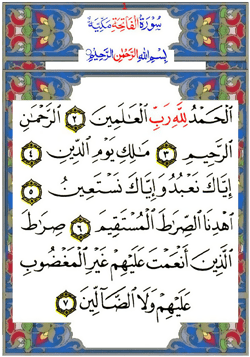
Al-Fatiha 

 Translation:

In the name of God, the All-Merciful, the Compassionate.

Praise belongs to God, Lord of the worlds,

the All-Merciful, the Compassionate,

Master of the Day of Judgment.

You do we worship, and from You do we seek help.

Guide us to the straight path,

the path of those upon whom You have bestowed favor;

not of those who have incurred wrath nor those astray.
IG Night Kick-Off

IG Night Kick-Off: MFCC and MSAs from area high schools present an Islamic Guidance (IG) kick-off event for all Muslim high schoolers, hosted by Universal School on Saturday, April 27 from 6-8 pm. We will have guest speakers, entertainment, and more.

Click To View