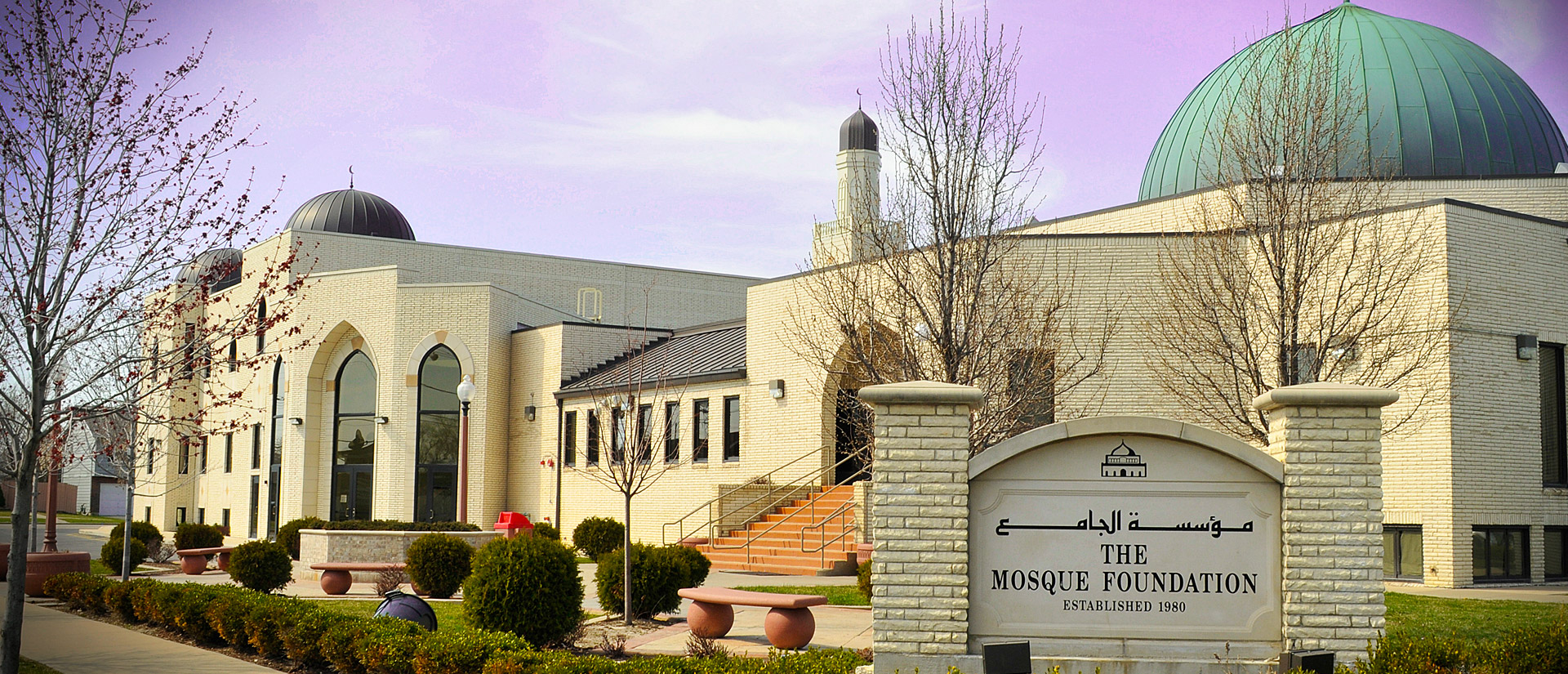
Mosque Foundation | Bridgeview, Illinois Logo
Mosque Foundation | Bridgeview, Illinois

Mosque Foundation

Special Needs

First Friday Prayer is at 12:30pm. Second Friday Prayer is at 2:00pm.

Special Needs

The Mosque Foundation is partnering with MUHSEN (Muslims Understanding and Helping Special Education Needs) to help families with special needs.

If you have a family member with a special need, please click on this link  to fill out our Special Needs Program Interest Form. Feel free to forward this form to other families in our community who have someone with special needs. All responses are confidential and will only be shared with the MUHSEN team.

Special Needs Information Form: Click here
For more information about MUHSEN, watch this video with Sh. Omar Suleiman or visit www.muhsen.org.

The Great Pillar of Hajj

“So complete the Hajj-Pilgrimage and the Umrah solely for [the sake of] Allah,”(2:196)

Dear Pilgrim,

The most beloved deeds to Allah are indeed those He (SWT) obligated on us. Abu Hurairah (R) reported that the Messenger of Allah (S) said, “Allah said, ‘Nothing brings my servant closer to me but what I have made obligated on him’.” [Bukhari] The pilgrimage in itself is a response to the call of Allah and it is during these rituals that the pilgrim fulfills the last pillar of Islam. The Prophet (S) said, “Islam is built on five; to witness that there is no god but Allah and that Muhammad is the messenger of Allah, establish prayer, give charity, fast Ramadan and perform Hajj.” [Bukhari]

Hajj requires much sacrifice including time, money and effort. The devotion required to perform the rituals of Hajj elevate you spiritually and increase your connection with your Creator. Muslim pilgrims share that when performing Hajj and even at the sight of the Ka’bah they feel the matters of this world desert their thoughts and very being as their souls ascend to their noble purpose for which they were created.

In performing this act of worship, a Muslim is granted mercy and forgiveness. A pilgrim is promised that his sincerity will cause him to return home with all of his sins forgiven like being born again. This purification from sins renews their faith and makes them steadfast and keeps Satan’s whispers away. Abu Hurairah (R) said, “I heard the Messenger of Allah (S) saying, “Whoever performed Hajj, did not encounter sexual relations and did not disobey Allah, he will return from his sins like the day his mother gave birth to him.” [Bukhari]

Hajj teaches the highest levels of patience. A pilgrim during Hajj bears the hardships of travel, leaves their family, deals with companions of the journey, shares crowded places, meets new cultures and lifestyles and so much more which require patience and self-discipline. Allah (SWT) says, “Allah is with those who are of patience,”(2:153)

Hajj provides the pilgrim with an opportunity to connect with their history as a Muslim. The pilgrim follows in the footsteps of Prophet Ibrahim (A), his wife Hajar and their son Ismail (A). Making tawaf allows us to share the experiences of both Ibrahim (A) and Ismail (A) as they walked around the Ka’bah praising Allah (SWT) and beseeching Him. As the pilgrim races to do sa’ee between Safa and Marwa he recalls the faith of Hajar who remained alone with her infant in the dessert with full reliance on her Creator. Tossing stones at Al-Jamarat reminds the pilgrim of the trials and tribulations Ibrahim (A) was challenged with as he submitted to His Creator’s command to slaughter his own son. Visiting Makkah and Madinah, the two cities which gave birth to our beloved Prophet Muhammad (S), his Sahabah (R), our faith, is one of the most unforgettable components of the pilgrimage experience.

During Hajj the pilgrim tastes a genuine sense of equality, unity and brotherhood. People of all different colors, races, cultures, and geographical areas all come together wearing the same clothes, uttering the same words, united under one theme of Tawhid, and join together in the same acts of worship before their Creator.

To all those who have been blessed with the opportunity to go to Hajj this year we remind you to be grateful to Allah (SWT) for allowing you to do so, to do your best to perfect your performance of Hajj, to make dua’a for your families and to ease the hardship of Muslims around the world.

May Allah (SWT) accept from you, reward you, and return you to your families and community safe and forgiven.

Ameen

Restore Hope Through Repentance

“And those who do not invoke with Allah another deity or kill the soul which Allah has forbidden [to be killed], except by right, and do not commit unlawful sexual intercourse. And whoever should do that will meet a penalty. Multiplied for them is the punishment on the Day of Resurrection, and they will abide therein humiliated. Except for those who repent, believe, and do righteous work. For them, Allah will replace their evil deeds with good. And ever is Allah Forgiving and Merciful. And those who repent and do righteousness do indeed turn to Allah with [accepted] repentance” (Quran 25:68-71).

In these verses, Allah, the Most High, articulates three types of transgressions representing three sin categories. He alludes to these three categories by mentioning the most heinous of each category of sin. To properly understand these verses, we need to understand the types of corruption apparent throughout the Quran.

  1. First, there is the gravest of all sins that Allah has deemed inexcusable and utterly most heinous; transgression in terms of Allah’s sole right to be worshipped alone without any partners. This is the worst of all sins. 
  2. Second is transgression in others’ rights through unlawfully taking the life of another human being. 
  3. The third transgression is against one’s soul that does not involve the direct infringement of another’s rights. The worst type of offense that wreaks the most havoc on the soul is fornication.

In a narration collected by both Bukhari and Muslim, Ibn Mas’ood narrates that he asked the Prophet ﷺ: “What is the gravest sin?” To which the Prophet ﷺ responded: “That you worship another along with Allah in spite that it is Allah (alone) who has created you.” Ibn Mas’ood then asked: “What is most grave after that?” The Messenger of Allah replied: “That you kill your own children for fear that they would infringe upon your sustenance.” Ibn Mas’ood finally asked: “What is most severe after that? The Prophet ﷺ said: “That you fornicate with your neighbor’s spouse.”

Through this narration, we see three categories of sin denoted by mentioning the worst of each. When we study the texts of the Quran and Sunnah, we see this pattern repeated often. For instance, Allah mainly says the people of paradise and their opposites: the people of hellfire. What about those in-between? Those who have mixed good and evil, righteousness and sinfulness? The Quran is a reference that is not only comprehensive but concise. Hence, Allah addresses and dwells mostly upon extreme examples: idolatry, murder, and adultery. We then are to deduce the ruling of the less severe.

When Allah speaks of those who disbelieve in their hearts, and consequently, their actions follow suit, we can deduce that their faith is contaminated, and their behavior is of the disbelievers. This is similar to a painter who starts with primary colors to make other colors and doesn’t have the color gray at their disposal. Instead, they need black and white from which to make any shade of gray for the intended task. Likewise, when Allah explains one extreme or primary condition to us, we can derive other shades from which apply to the present.

In the end, the verses remind us that Allah’s mercy always prevails and that we should never give up hope in receiving or restoring Allah’s favor. Those who sin but repent in good conscious, turn to Allah, and follow their renewed intentions with purposeful actions are promised forgiveness and acceptance.


By Sh. Ali Mashhour


Rights for Those Who Repent by Sh. Ahmed Arafat

As humans, we are all susceptible to committing sins and yet, the best amongst sinners are those who repent. Even though to err is human, those who turn to Allah may hear insensitive comments, notice suspicious glances, or experience social rejection. In compassion with newcomers and to draw them closer to Allah, Imam al-Jilani (d. 561 AH/1166AD) explained four rights for those who repent:

1. Love
Those who seek Allah should not only be welcomed but loved as well. This right is Quranically grounded by Allah: “Indeed, Allah loves those who repent and those who purify themselves”(Quran 2:222). Failing to show love is a sign of spiritual pride. Furthermore, our hearts should be filled with joy as we see someone coming back to Allah. As the newcomers expect to receive Allah’s love, they deserve to sense our love as well.

2. Prayer
The second right is to pray sincerely for their istiqamah or steadfastness of those who repent, especially in the beginning of their repentance as they will feel the pain of separation from their old habits. Furthermore, the new lifestyle could come with challenges and obstacles; not all will be sunshine and roses. Sincere prayers emanate from a heart that has compassion for people and a pure desire for their transformation. Being kind hearted is a prerequisite for dealing with those who are seeking repentance. The Quran describes the Prophet as, “A Messenger has come to you from among yourselves. Your suffering distresses him: he is deeply concerned for you and full of kindness and mercy toward the believers” (Quran 9:128).

3. Forgiveness
We should always keep in mind that sin and forgiveness are between the sinner and Allah, alone. There are those who sin against Allah, but Allah promises them forgiveness when they turn to Him in repentance. So, we have no right to interfere in this relationship. Reminding people of their past transgressions could make them give up on their new life as they feel incapable of overcoming the new changes.

4. Friendship
Muslims with compassionate hearts will always seize each opportunity to uplift and strengthen each other. Newcomers deserve to take comfort in the ease of our smiles and the willingness of our hearts to help. Building a loving relationship with them and inviting them to the masjid’s classes will help them improve and strengthen their relationship with Allah.

5. Patience (I added this to the list)
Many of us tend to demand too much, too soon from newcomers and expect them to start with what we have developed over many years without realizing the patience this requires. If we insist that an infant must eat adult food, for example, we will certainly damage their growth. In the same sense, we must exercise an immense degree of patience and tolerance when dealing with new Muslims and those who repent so that they too, will find their way to faithfulness, insha’Allah. We ask Allah to fill our hearts with love, prayer, forgiveness, friendship, and patience.

Our Father’s Great Sacrifice: Why We Celebrate Eid ul Adha

And he said, “Indeed, I will go to [where I am ordered by] my Lord; He will guide me. My Lord, grant me [a child] from among the righteous.” So We gave him the good news of a forbearing boy. And when he reached [the age of] serious work with him, he said, “O my son, indeed I have seen in a vision that I [must] sacrifice you, so see what your opinion is.”He said, “O my father, do as you are commanded. You will find me, if Allah wills, of the steadfast.” And when they had both submitted and he put him down upon his forehead, We called to him, “O Ibrahim, You have fulfilled the vision.” Indeed, We thus reward the doers of good. Indeed, this was the clear trial. And We ransomed him with a great sacrifice, and We left for him [favorable mention] among later generations” Peace upon Ibrahim”  (Quran 37:99-109).

In these verses, Allah relates to us one of the most profound instances of total servitude to Him that has ever been exhibited in human history. We are told of Ibrahim migrating from his people and his home to find a place to worship Allah in safety. His people, his own family including his father attempted to kill him. When this failed, Ibrahim turned to Allah in hijrah (migration) with total conviction and trust that Allah would be his keeper on this journey. He left with only his dutiful wife, Sarah, saying to her at one point: “Sarah, there isn’t on the face of the earth a believer aside from you and me” (Sahih Bukhari: 3358/ Sahih Muslim: 2371).  Despite this profound loneliness and great fear of his legacy dying with him, he persevered, praying to Allah for a righteous offspring to carry his heritage. We do not know how many years passed between Ibrahim’s supplication and the gift of a son, but according to some historians, such as Ibn Katheer, it was at least twenty years. 

After much prayer, patience, and trust in Allah, at the age of 86, Ibrahim was finally granted a son of piety and righteousness. But with every blessing comes a test. That test is always fashioned to penetrate our deepest corners; to test the depths of our souls and push our buttons as it were, to increase the wicked with wickedness and the righteous with strength and resilience. After so much waiting, no sooner was he blessed with his son, Ismail, than he was to be taken away, and not just by anyone or anything, but Ibrahim was to take his son’s life with his own two hands, the same two hands he had raised so many times asking Allah, begging Allah for this invaluable gift. Ibrahim was commanded to slaughter his one and only son. Ibrahim never wavered, not even for a moment, saying: “I have seen in a vision that I am slaughtering you, so tell me then what your opinion is.” We notice how Ibrahim never lost his total trust in Allah not even for a moment, so much so that he did not ascribe the command to Allah as it may imply some sort of folly to Allah’s command in the mind of the listener. The command to slaughter such a righteous boy while the earth is filled with unworthy souls is not something the rational mind can easily understand. One may question, why? What good could possibly come from such a command? Yet this question never came up.

Neither Ibrahim nor Ismail ever questioned Allah’s command; they were in total submission and obedience to Allah and His will. As Ibrahim took his only son and laid him on his belly, so as not to look into his eyes as he drew his final breath, he takes the sharpened blade and runs it across his beloved’s throat. Suddenly, a piercing light came through the darkness bestowing Allah’s relief. Ibrahim fulfilled Allah’s command without shedding his son’s blood. “Indeed Allah does not judge you based on neither your outward images nor your wealth, rather He judges you based on your hearts and actions” (Sahih Muslim: 4779).  Ibrahim took every step with the intention to slaughter his son as commanded, yet Allah decided a different outcome. Ibrahim was given a ram in his son’s stead, to be slaughtered and the meat to be distributed to feed the poor and needy. Hence, Ibrahim fulfilled his destiny to become the Father of the Prophets as it were, one who was willing to slaughter his own flesh and blood to feed the needy amongst his followers. He became, as Allah said: “And mention, when Ibrahim was tried by his Lord with words [i.e., commands] and he fulfilled them. Allah said, “Indeed, I will make you a leader for the people” (2:124). 

This great sacrifice our Father Ibrahim made on our behalf, his ultimate reliance on Allah and his subsequent reward, is honored as Eid ul Adha. This is why we celebrate every year on the 10th day of Dhul Hijjah. Ibrahim was tested with the most unfathomable test. We are to merely carry on this legacy. We do not slaughter our children nor are we commanded to; we are instead instructed to reap the fruits of our forefather’s sacrifice and continue this tradition for generations to follow. It is for this reason the Prophet Muhammad (PBUH) says: “Whoever does not sacrifice whilst having the ability to do so, should not even come near our place of prayer” (Ibn Majah: 3123). In other words, it is as If to say, if you do not do your part to uphold the legacy of Prophet Ibrahim, so long as you are able to, then as a Muslim, you have missed the entire point of what we celebrate on this day.

By Sh. Ali Mashhour
40 Hadeeth of Imam al-Nawawi

Learn the Foundations of Islam Through the 40 Hadeeth of Imam al-Nawawi

This class is held every Thursday at 7:00 pm in the Mosque Foundation and is presented in English by Sh. Ahmed Arafat. Sh. Ahmed selects one hadeeth per session to thoroughly explain the correct understanding, as well as its practical application in our daily lives.

Sh. Ahmed points out that the highly respected scholar of Islam, Imam al-Nawawi, precisely included these 40 hadeeth to represent the basic foundations and rules of Islam as they should be understood and practiced by every Muslim. Imam al-Nawawi declared these 40 hadeeth to be universal maxims which guide different aspects of our lives, including protecting our hearts, leaving that which does not concern us, Islamic manners, the forbiddance of anger, and attaining nearness to Allah. All of the topics discussed in this series have the aim of increasing religious literacy.

In addition to gaining the benefit of growing our religious knowledge and increasing our practice of Islam, attending this program gives us a chance to connect with the Masjid. Sh. Ahmed reminds us of the importance of making the Masjid a part of our weekly if not daily lives; for those whose hearts are attached to the Masjid will enjoy the shade of Allah on the day when there will be no shade except His.

Men, women, young, and old, are welcome and encouraged to attend this invaluable series. By the end of the series, you will have the privilege and advantage of having studied the 40 Hadeeth of the Prophet Muhammad (PBUH), which Imam al-Nawawi carefully studied and prepared for us over 800 years ago.

For more information about the class or if you have any questions, you may contact Sh. Ahmed at: aa@mosquefoundation.org.

Eid Ul-Adha


New Muslim Dinner

On Saturday, June 8, 2019, the Mosque Foundation held an annual Eid dinner for new Muslims and their families. New Muslims are an integral part of our Mosque Foundation community and it is incumbent upon us to welcome and support them in any way we can. Ruth Saleh, a longtime member of the Mosque Foundation community is now also a longtime Muslim, but she recalls the loneliness and isolation she felt when she first converted to Islam. “As a young person who comes from a long line of traditional Mexicans, it was truly a life-changing decision I made over 30 years ago to leave my non-Muslim culture behind and embrace Islam,” she said. Ruth is confident and secure in her decision, but nonetheless, understands the need for community centers to rally around new Muslims.


Our New Muslim Eid Dinner was packed with over 200 diverse attendees which included African Americans, Latinos, Caucasians, Philipinos, and others. The event was held at Universal School. President Oussama Jammal delivered the opening remarks, while Sh. Ali Mashhour gave a short talk. The rest of the time was spent enjoying dinner catered by Al-Bawadi restaurant and socializing with new and old friends. Children got henna tattoos and laughed with the entertaining clown. For some of the attendees, both Muslim and non-Muslim, this was one of their first times associating with the Masjid and experiencing the acceptance and support of a welcoming community that encourages them to take part in activities.


We look forward to continuing the tradition of highlighting minority Muslim communities and encouraging new Muslims to participate in programs and events.

[smls id=”5125″]


Volunteer Appreciation Iftar

On May 31, 2019, we invited our hard-working volunteers to an appreciation iftar. Around 200 volunteers enjoyed a relaxing iftar with friends. The Mosque Foundation has been holding this annual event for over ten years. The volunteer leaders, Habbis Abdallah & Fawzy Hassan,  Sr. Aisheh Said, as well as the entire Mosque Foundation Community deeply appreciate the loyalty and diligence of these volunteers who dedicate countless hours every year, and especially during the busy season of Ramadan, to help ensure that all worshippers enjoy the benefits of the Masjid.

Special guest speakers included Sh. Jamal Said, Sh. Ali Mashhour, and President Oussama Jammal. They each spoke about appreciating our volunteers’ service and commitment to the Masjid. We thank our volunteers today and every day and pray to Allah to reward them for their efforts.

[smls id=”5112″]

Qiyam Led by Our Youth Huffaz

In 2013, the Mosque Foundation and the Muslim American Society (MAS) created a unique Quranic Hifz (English) program where students not only memorize the Quran but learn the meaning behind the recitation. The goal is to produce quality Quran teachers who are secure in their faith and qualified to lead the next generation. This Ramadan of 2019, the program is flourishing with 36 students, 10 of whom are females. Classes are led by Ahmed Alsheikhi and Moath Alshanti, in the Mosque Foundation Education Center (MFEC).
 
As part of the Mosque Foundation’s Ramadan prayer schedule during these last ten blessed nights, we have Qiyam at 2:30 am led by six Huffaz from the program. They are: Ibrahim Salah, 20, Salem Abuammer, 20, Mallek Nahhas, 21, Ahmad Kawji, 20, Sharaf Atwa, 21, and Mohammed Zahdan, 20.
 
As you can see, these young men have dedicated their time to learn the book of Allah and are putting their training to practice. Not only are they spending a significant amount of time with their loyal mentors to learn the Quran, but these young men are also full-time higher education students. They are on their way to becoming leaders in their respective fields of medicine, engineering, education, and so on. May Allah continue to bless and guide them and their families.

[smls id=”4900″]

Lailatul Qader program


إحياء ليلة القدر

Lailatul Qadr Program


When: Wednesday, April 27, from 9:30 PM until Thursday Fajr Prayer

With our Imams: 10 PM to 11 PM in the Masjid & at Facebook LIVE

Qiyam: 12:30 AM

Suhur: will be provided

Fajr: 15 minutes after Athan


Guidelines for the Lailatul Qadr Program

  • 12- to 16-year-olds may attend Taraweeh and Qiyam accompanied by a parent.
  • Sisters who are excused from prayer are kindly asked NOT to attend Qiyam or the Lailatul Qadr program due to limited space.
  • Sleeping bags, pillows, blankets, etc. are NOT allowed in the Masjid.